

Reclaiming the Radical Legacy of Dr. Martin Luther King Jr.
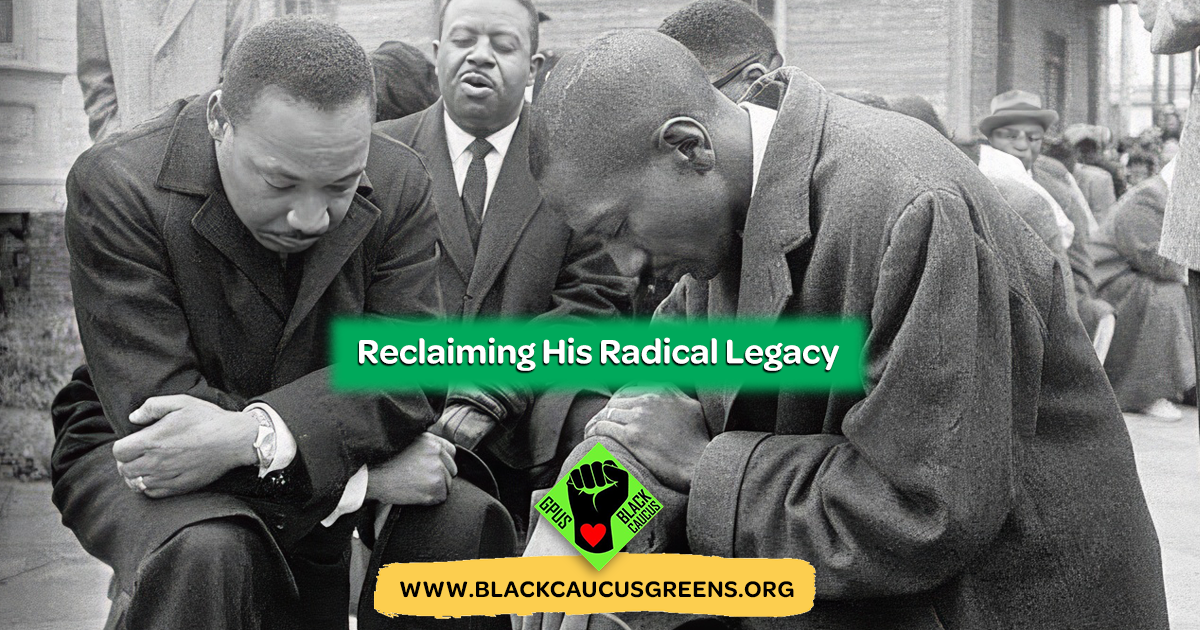
As we raise our voices in celebration of his legacy, we honor not the sanitized symbol, but the revolutionary Dr. Martin Luther King Jr. The man whose true vision necessitated his suppression. The powerful have crafted a palatable dream, scrubbed clean of his radical economic analysis, his socialist leanings, and his profound indictment of a system built on the triple evils of racism, materialism, and militarism. It is this edited, non-threatening version that is enshrined in our schoolbooks and national celebrations, a deliberate erasure designed to neutralize his revolutionary call.
The true Dr. King was executed for a reason. He was moving beyond civil rights to human rights, declaring that "capitalism does not permit an even flow of economic resources," and calling for a "radical revolution of values." His vision was not merely about integration into a broken system, but the transformation of the system itself.
This uncompromising vision finds its natural political home in the Green Party and its Four Pillars. Dr. King didn't use our terminology, but his life's work embodied these principles through direct action:
- Ecological Wisdom & Social Justice: King’s final campaign, the 1968 Memphis Sanitation Strike, was a fight for both dignity and public health. He stood with Black workers exposed to toxic conditions and brutal exploitation, linking environmental safety with economic justice -- a clear precedent for our fight against environmental racism.
- Grassroots Democracy: The 1966 Chicago Freedom Movement confronted segregated housing not just with marches, but by organizing tenants unions, challenging racist banking and real estate practices, and demanding community control over housing -- a foundational act of grassroots democratic mobilization.
- Social Justice & Economic Transformation: The Poor People’s Campaign was his radical, multi-racial mobilization to demand an Economic Bill of Rights. He called for guaranteed annual income, affordable housing, and the right to employment. This was a direct challenge to the capitalist order and a blueprint for our Green New Deal and economic justice platform.
- Nonviolence: King’s unwavering commitment to nonviolent direct action, from Selma to his bold denunciation of the Vietnam War, was a strategic and moral force that exposed state violence. His nonviolence was not passive. It was a militant, disruptive tool for revolutionary change, aligning perfectly with our pillar’s commitment to peacebuilding and demilitarization.
The National Black Caucus of the Green Party stands firmly on these Four Pillars and on this complete, unedited legacy of Dr. King. We reject the hollow celebrations and commit to the dangerous, transformative work he was leading when he was executed.
The work continues. We honor him through action.
We call on you to:
1) Study the uncut speeches: "Beyond Vietnam" and "Where Do We Go From Here: Chaos or Community?"
2) Organize locally around the intersections of poverty, racism, and ecological crisis, as he did.
3) Join the National Black Caucus to build independent political power rooted in this radical tradition.
4) Demand policies that realize the Economic Bill of Rights he fought for, through our Green Party platforms.
Let us move beyond the dream that was sold, and take up the revolutionary work that remains.
The Green Party doesn’t allow our revolutionary work to be corrupted by corporate donations and SuperPACs. We rely on supporters like you to grow our independent political power. Could you donate today, or even consider becoming a monthly sustainer so we can get strong enough to take on the two parties of war and Wall Street?
In solidarity and relentless struggle,
The National Black Caucus of the Green Party
www.blackcaucusgreens.org
P.S. The work of the National Black Caucus of the Green Party seeks to make Dr. King’s dream a reality. Could you donate to us today to help us in our mission of true racial equality and justice?
Photograph: Civil-rights leader Martin Luther King Jr. kneeling with a group in prayer in Selma, Ala., in 1965. BETTMANN ARCHIVE

Showing 1 reaction